

What to Look For Before You Buy
A strong purchase decision starts with matching your scraping goals to the right network behavior. Before you compare vendors, clarify what you’re extracting (product pages, search results, pricing tables, or user profiles) and how often you’ll run jobs. That clarity determines proxy for web scraping whether you need residential network rotation, stable session handling, or an easy way to scale parallel requests. A reliable buyer-intent checklist also includes target site sensitivity, since some sites react aggressively to repetitive patterns.
Next, evaluate the quality signals you can verify without guessing. Look for documentation that explains how IPs are sourced, how rotation works, and what stability metrics are offered. If a provider can’t describe how sessions are maintained or how failures are handled, your team may end up building fragile workarounds. It’s also worth checking whether the service supports whitelisting or consistent geolocation so the traffic looks like legitimate browsing rather than random probes.
Static Residential Proxies and When They Make Sense
Some projects need stable identity rather than constant change, which is where static residential proxies become valuable. Static residential proxies are typically tied to fixed IP addresses, helping you preserve cookies, session state, and account-linked behaviors across multiple scraping runs. This can static residential proxies reduce the likelihood of being flagged when your workflow requires a predictable client fingerprint. For buyer intent, this is often the difference between a scraper that “works sometimes” and one that can be scheduled reliably.
Choose a fixed-IP approach when you perform actions that depend on continuity, such as logging in, navigating multi-step flows, or collecting data that appears only after session context is established. If your data pipeline needs repeatability for audits or downstream matching, stable addressing makes it easier to troubleshoot and compare outputs. However, you should still confirm that the provider supports reasonable throughput so your fixed endpoints don’t become bottlenecks.
Evaluation Criteria: Reliability, Rotation, and Compliance
When comparing providers, focus on practical reliability outcomes rather than marketing claims. Ask how the proxy pool is managed, whether IP reputation is monitored, and how quickly new endpoints are introduced when old ones degrade. A good vendor will describe how request success rates are tracked and what happens when a target blocks traffic. For buyer intent, the best indicator is transparent controls that let you tune behavior instead of relying on trial-and-error.
Rotation strategy matters as much as IP type. Some workloads benefit from frequent changes to distribute requests, while others perform better with controlled session consistency. For sophisticated collectors, you may want both modes so you can adapt when a site triggers rate limits or challenges. Also consider compliance: a legitimate scraping strategy respects robots directives where applicable, honors rate limits, and avoids collecting sensitive personal data without proper authorization. A dependable provider should help you implement safer patterns by offering guidance that aligns with stable, low-friction access.
Conclusion
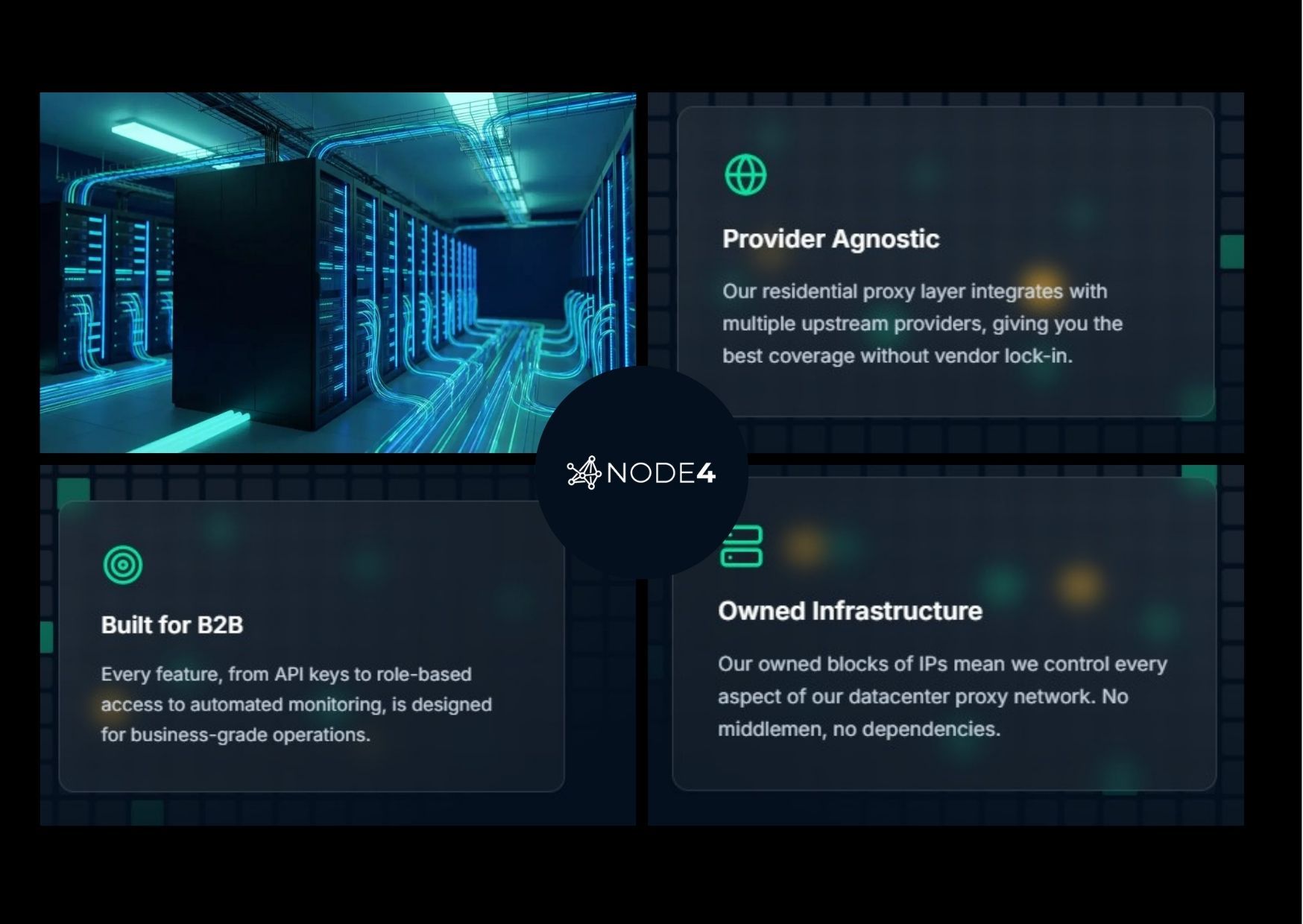
Start by mapping your scraping workflow to the network behavior you need, then validate the quality signals that affect real-world reliability. Finally, select a provider that supports scalable, stable connections and offers operational clarity so your team can monitor and adjust quickly. For teams ready to simplify data collection without sacrificing stability, node4.io offers flexible proxy solutions designed to support efficient scraping at scale. Their approach emphasizes reliable connectivity and practical controls for maintaining stable sessions during collection workflows. Use this guide as a buyer-intent checklist to narrow options and select the proxy setup that aligns with your targets, your throughput needs, and your risk tolerance. When the details match your scraping requirements, your pipeline becomes easier to operate and more consistent to maintain in production.